

Beyond Isolated Action: Impactful Partnerships To Decarbonise The Built Environment

On 5th March 2025, Pineapple CoRE hosted a panel at Sustainability Live: Net Zero Summit. Featuring leaders from DCC Energy GB, Schneider Electric and Signify, the discussion moved beyond the "why" of sustainability and into the "how" of commercial success.
The consensus? Bold partnerships offering integrated technology and tailored financing are the new blueprints for real estate decarbonisation and resilience.
Read our summary of insights and key takeaways from the panellists. Access full video recording below.
1. The Renovation Gap
The global built environment is at a critical juncture. Buildings are responsible for nearly 40% of global energy related carbon emissions (UNEP) and 80% of buildings that exist today will exist in 2050 (World Economic Forum).
The real challenge - in the Global North - isn’t building new "green" structures; it’s the Renovation Gap. Emerging markets are able to implement new, efficient assets, the developed world has to address its aging stock. To protect and enhance asset value, property owners must overcome three systemic barriers:
Upfront CapEx: High initial costs for deep retrofits
Technical Skills: A growing internal "knowledge gap" around what is possible and how
Fragmented Supply Chains: A siloed approach that leads to "problem-solving on the job"
2. Perception Gap: The Will to Decarbonise Remains Strong
There is a perception that sustainability is costly. The business reality on the ground is that the will to decarbonise remains strong. The key business motivation has moved from decarbonisation to resilience.
One of the most urgent warnings came from Alice Steenland, Chief Sustainability, Strategy & Marketing Officer at Signify, regarding the rise of "greenhushing", a phenomenon where companies continue their climate work internally but have become silent publicly to avoid political friction.

"Political backlash... risks eroding climate ambition through silence. Companies that stop talking about sustainability actively undermine progress, even if they continue acting on it internally."
Alice highlighted that while lighting is often considered a solved problem in buildings, it remains responsible for global emissions equivalent to the entire global aviation industry. In some buildings, lighting can represent up to 30% of total electricity consumption.
“LEDified countries are not the most developed countries. It’s the emerging markets that have a higher standard of LEDification, than the developed world. Why is that? Because nobody is renovating. We have old building stock, we’re not renovating, and the lights don’t get changed unless you renovate. So that renovation guidance is really important, it’s one of the things Signify push for.”
3. Partnership Model: A Strategic Necessity
Ultimately, no single organisation possesses the full suite of skills, solutions, technology and financing required to help property owners meet decarbonisation and commercial targets.
The panel argued that the traditional procurement model, where an asset owner manages a siloed list of vendors, is fundamentally broken for complex decarbonisation projects.
Solutions such as Heating, Ventilation, and Air Conditioning (HVAC), lighting and insulation should be treated as integrated projects to reduce friction and accelerate energy efficiency gains.

Rupert Snuggs, MD of Pineapple CoRE and panel Chair, stressed that:
"Early, integrated engagement is key: bringing together technology, financing and sustainability partners at the outset of a client project yields significantly better outcomes than sequential, siloed approaches."
Rupert highlighted that a single-site project under the Pineapple CoRE partnership model could achieve 40% reduction in energy costs and up to 90% carbon reduction.
Kas Mohammed, Vice President of Advisory Services at Schneider Electric offered an example of a partnership with one of the UK’s largest district heating and mechanical/electrical systems companies. Previously, the two firms operated in parallel or as simple suppliers. A project in the East Midlands served as a catalyst for a more standardised, early-engagement approach.

Key insights from this example include:
Solving Problems Upfront: Traditional models often lead to "problem-solving on the job," which increases costs and timelines for the customer.
Off-Site Innovation: By partnering early, the teams can embed digital technology directly into prefabricated mechanical systems before they even reach the site.
Mutual Technology Advantage: The partnership allows the mechanical firm to better understand Schneider Electric’s software capabilities, enabling them to get more value out of their own hardware components.
Kas summarises the shift from reactive supply to proactive partnership:
“Having early engagement as we’re going into an agreement and bringing a couple of end users as well into that kind of partnership has allowed Schneider to work on more of a what can we do off-site. The priority is not just new technology, but understanding how poorly current systems communicate with one another and addressing that through smart integration."
4. Green Investments: A Direct Profit Centre
To address the financial barriers asset owners face when progressing with decarbonisation retrofits, the panel introduced the concept of Blended Finance. This approach can remove Capital Expenditure (CapEx) hurdles and solves the issue of varied return timelines.
The Strategy: High-return projects (like LED lighting with an 18-month Return on Investment - ROI) are bundled with long-term infrastructure (like heat pumps or deep insulation)
The Result: The combined package meets corporate investment hurdles, allowing for deeper decarbonisation that might not have been possible
David Taylor, Commercial Director at DCC Energy GB, highlighted that energy, as well as being a commodity to be procured periodically, is a strategic asset.
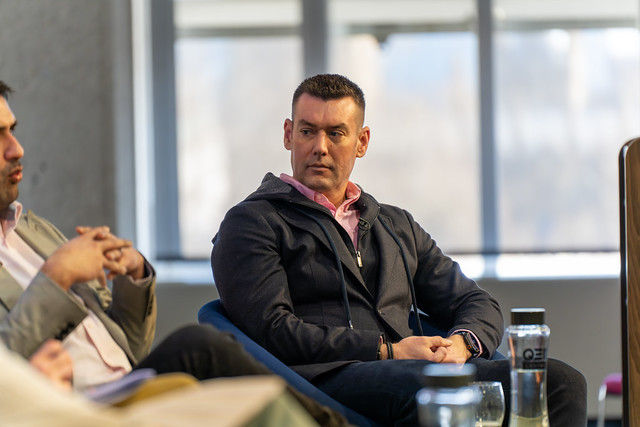
"Organisations that treat energy as a strategic, ongoing commitment, rather than a periodic procurement exercise, will be better placed to manage market volatility and capture cost savings."
Furthermore, the secondary benefits include lower insurance premiums through better system monitoring, increased asset value and positive PR.
For example, early adoption of Power Purchase Agreements (PPAs) has seen Signify earn over €25 million in profit, proving that green investments can be a direct profit center.
5. The Skills Gap
Kas Mohammed stressed:
“that many of Schneider Electric’s customers don’t have that detailed view of the different systems and the technology that is available because of the pace of change of the skills in their business. So they need more support from the industry, but who can they rely on and who can they trust?”
He emphasised that by partnering with global market-leading solutions, finance and delivery providers, organisations can adopt a 'knowledge-as-a-service' model. This helps to bridge the skills shortage gap that many businesses face, where internal teams lack the technical depth and bandwidth to manage complex multi-vendor net-zero transitions.
6. Non-Negotiable: Data, Measurement, And Continuous Monitoring
The panel emphasised that decarbonisation is an ongoing programme, not a one-time project. Without robust baseline data, organisations cannot identify where to start or track progress over time. Real-time monitoring of energy consumption, combined with live assessment of technology costs and regulatory changes, enables smarter and better-timed investment decisions throughout the lifecycle of a building.
Decarbonising a diverse real estate portfolio requires moving beyond guesswork toward a disciplined, data-driven framework. Using the Royal Botanic Gardens, Kew, as a primary example, Kas Mohammed highlighted that even the most historic and complex sites - ranging from Victorian glasshouses to modern offices - must follow a rigorous hierarchy of digital transformation. He argues that many organisations are still skipping the fundamentals, stressing that the industry cannot reach the optimisation phase without first establishing a baseline through comprehensive measurement and active control.
"They’re having to ultimately understand what it is that they’re not measuring today. Start measuring it, put the data in place... It’s three very simple steps…”
Measure: You cannot manage what you do not measure. This requires a ground-up audit of existing energy performance and the identification of data gaps.
Control: Use the collected data to automate systems, eliminating the manual waste inherent in older building stock.
Optimise: Deploy connected technologies to fine-tune performance over the lifecycle of the building, reacting to real-time changes in energy prices and legislation.
Panel Takeaways:
Start measuring. You cannot manage what you cannot see. Audit your buildings’ energy performance today — including lighting, HVAC, and control systems — and identify where data gaps exist.
Rethink your stakeholder map. Bring your CFO, sustainability lead and IT team into decarbonisation conversations from the outset. These decisions are no longer solely an estates or facilities management matter.
Explore partnership-based financing. The barrier of upfront capital is being removed. Engage with integrated solution providers who can offer energy-as-a-service models that deliver cost reductions from day one with no balance sheet impact.
Keep talking. At a time of political headwinds, maintaining public and internal visibility of sustainability commitments matters. The market is moving; organisations that go quiet risk losing the momentum they have built.
Think long-term. Treat energy as a strategic asset to be actively managed over years, not a commodity contract to be reviewed and forgotten. The businesses that build resilience now will hold a material commercial advantage as energy costs continue to rise.
Need Our Help?
The Pineapple CoRE partnership brings together market leading technology, delivery and financing capability, underpinned by £50m funding. Together with DCC plc, Signify, Schneider Electric and EVORA Global we finance and execute commercial and industrial real estate projects that deliver upgrades, energy savings and exceed returns targets.
Get in touch today to book a discovery call: core@pineapplepartnerships.com

